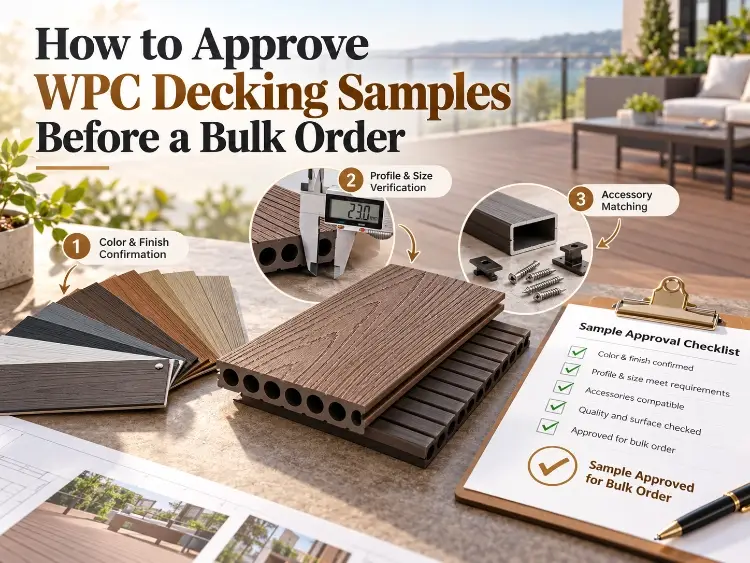
The sample request usually starts with a photograph attached to an RFQ. A screen shows a color and a grain pattern; the board itself — its edge, its hollow chambers, the feel of its surface — stays hidden. The physical piece is what an approval can rest on: something the buyer can measure, cut, and stand on the actual terrace. This article walks through that check in order — the WPC decking sample approval: what to record, what to compare, and what to sign before a bulk order moves.
The piece then does a second job. Distance usually gets in the way: the purchasing desk sits in one country, the inspection team in another, and the two argue from different photographs. One retained sample ends the argument. The buyer checks WPC decking color samples against it in the light at the site, handles the composite decking finish sample, and files the exact configuration behind the quotation.
Why a Digital Color Reference Is Not Enough for a Bulk Order
A screen does not fix the finished appearance
Grey boards cause the most arguments. The same board reads cold against a white rendered wall and warm next to teak furniture, and a phone screen or a compressed catalog file shifts it once more before anyone has seen the real piece. The edge, the hollow chambers, and the way the pressed grain flares in low sun never reach the screen at all. So WPC decking color samples go to the site or the showroom and lean against the real paving and facade. Each photograph records the face and the edge with the light noted — morning shade, noon sun, the terrace lamps after dark. When the pre-production boards arrive weeks later, the inspector compares them with those photographs and the retained piece, and a difference is either there or it is not.
A sample captures more than color
Flip the board. The cut end shows wall thickness and chamber shape at a glance, and a thumb dragged across the face finds a wrong grain faster than a spec sheet does. A composite decking finish sample can match the shade and still carry the wrong profile; shade is all it approves. Everything else — dimensions, structure, accessories — needs its own line on the sheet, marked checked or still open. A signature in the wrong box has a way of becoming a technical certificate nobody meant to issue.
Record the Exact Sample Identity
Build the sample record before judging the finish
Label the board the day it arrives, before the color argument starts. A working record is plain: product line and model or profile, material and core, surface or finish reference, sample ID, date received, supplier contact, dimensions, intended use, installation system, accessory set. Together they mean a delivery driver, a warehouse clerk, and an inspector are all looking at the same named board — not at “the grey one” from an old email thread.
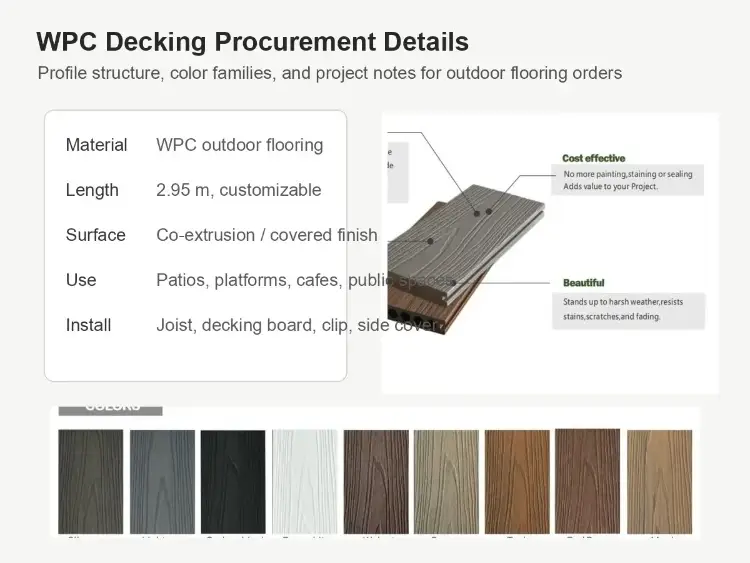
Say the buyer is reviewing WPC Decking TB140H23-CR. “Outdoor grey board” identifies nothing. The model’s listed configuration is an outdoor WPC flooring board, length 2.95 meters and customizable, with width and height set by the selected profile. Those figures describe this model. They say nothing about the board in the next folder.
Define what the approval covers
Then the sheet states what the signature actually covers, in one sentence: “Approved for appearance and configuration,” or the longer version with dimensions, profile, and accessory matching added. Where the project still owes a load, slip, fire, or UV document, the sheet carries an open-items field for it. The record also names what is physically in hand — full board, cut section, corner detail, or a single accessory — because one outdoor range mixes cores and surface constructions, and the label is how a quiet swap gets noticed.
Check Color and Finish Under Real Conditions
Compare the sample in the project light
Light changes its mind three times a day, so the sample has to be seen in all three: direct sun, open shade, and the artificial light the finished deck will use at night — against the real facade, against the real paving. If the tone swings red in the evening or grey in the shade, the buyer writes the swing down. “Cooler in shade, warmer under the terrace lights” is a sentence the next buyer can act on; “same as sample” is not. For stock, the retained WPC decking color samples stay in a fixed order, and every photograph uses the same position, the same light, and the same edge in frame.
A quick finish check
The finish check works best at a raking angle, board held low, because gloss patches and a shallow emboss show up there, invisible in a flat product photograph. Fingertips help; they catch what the eye skips. Where the deck meets other materials — painted metal handrails, stone steps, glass panels — the buyer lays offcuts of those materials beside the composite decking finish sample. A contrast that looks mild on a single board reads much stronger across a full terrace.
The record then fixes the finish in words: approved color reference, grain direction, finish name, which face stays exposed, and how much variation the buyer accepts between boards. The next composite decking finish sample is measured against those lines. Any drift shows up as a written difference while the boards are still at the factory.
Verify Profile, Core, and Dimensions
Confirm the board structure
Start at the cut end; it tells the truth faster than the face. Hollow-core, solid-core, and co-extrusion boards can share a color and share nothing else, and HUAHONG DECOR’s outdoor WPC category lists products under exactly those constructions. The sheet therefore carries the construction by name, next to the core shape, the wall thickness, the cap layer, and the edge detail measured off the piece. If the drawing depends on an edge treatment, the buyer asks for a section drawing or a marked sample while the quotation is still open.
Confirm dimensions against the installation layout
Measurements come off the sample itself, with a tape or calliper, not out of a chat thread. Length, width, height, and usable face go on the sheet, each with the tolerance the buyer will accept. For TB140H23-CR the listed length is 2.95 meters, customizable; width and height come from the selected profile, so the sheet carries the measured figures for the board in hand. The board then goes onto the joist and perimeter layout, where the joint pattern, the cut at the wall, and the meeting point at a drain stop being guesses. The WPC decking specification guide gives the buyer the question list to run alongside the drawings.
Confirm Fasteners, Keels, Edges, and Accessories
Keep boards separate from DIY tiles
“WPC decking” in an internal catalog can mean the long board or the small interlocking tile, and the two need separate sample sheets. The DIY WPC decking tile is the small format: 30 cm × 30 cm × 2.1 cm, interlocking. TB140H23-CR is the long board that runs on keels. Because coverage, layout, and accessories differ, a WPC decking bulk order sample declares its format on the label — board or tile — together with its dimensions and installation method.
Match the parts to the profile
Boards do not install themselves, so the sample sheet names the parts that belong to the profile. Keels or joists, screws and clips, starter and finishing pieces, side covers, end caps, and edge trims all go on it. For TB140H23-CR, the described fixing route connects the hardware to a metal keel or a WPC keel with nails, and the contractor checks that route early — against the substrate, the spacing, the drainage fall, and the tools on site. Whatever is missing gets ordered as an accessory set, and the sheet records the face orientation, the joint gap, the corner treatment, and the finish of exposed ends. A replacement finish sample becomes the reference only once it matches the approved piece on profile and fixing system, not before.
Turn the Approved Sample into a Production and Repeat-Order Reference
Sign a written approval with a change rule
Month six is when the sign-off page earns its keep. By then the people who approved the color may have moved to other projects, and the page is what remains: date, product and model, color, finish, structure, dimensions, accessory set, sample ID, photographs, and who may accept a change. Underneath, a single line names the changes that force a fresh comparison — a new pigment, new surface tooling, a different cap construction, a changed profile or length, a new packaging label, a different accessory. With that line in place, the factory inspector and the contractor can both work from the page without calling a meeting. Project tests and site installation details sit in the open-items column, where they belong, instead of sheltering inside an appearance approval.
Preserve the reference for repeat orders
The signed page is filed with the quotation, the purchase order, the packing reference, and the inspection record. The next pre-production sample gets the same treatment: same light, same tape, side by side with the retained board. Each photograph carries the production or batch date, because without it a visible shift in a later run cannot be traced to when it appeared. For the next project, the buyer reopens the HUAHONG DECOR outdoor WPC decking range and sends the new details in for a sample and a quotation.
Questions to Put on the Sample Sheet
Most sample-to-delivery failures trace back to one of seven checks. They belong on the RFQ, or on the sample sheet that travels with the board:
- Exact identity — model, profile, core, surface construction, and color reference.
- Dimensions — the fixed figures, the customizable figures, and the tolerance on each.
- Format — long board or DIY tile, with the installation method named.
- Fixing and accessories — keel, clips, nails, screws, edge trims, and end caps that match the profile.
- Finish reference — the retained sample that pre-production boards and repeat orders will be judged against.
- Open performance documents — any load, slip, fire, or UV requirement that appearance approval does not cover.
- Change rule — which changes to material, tooling, finish, or accessories require a new approval.
Checks six and seven carry the color-fastness question. Buyers ask “how to test WPC decking color fastness” as if the eye could do it; the eye can only catch a shade or finish difference under the project’s light. The requirement itself closes with paper: the supplier’s test method, the result, and the exact product scope the result covers. The sheet keeps the two in separate fields, so the visual result never borrows the authority of a test, and the test never has to carry a color decision.
Conclusion
One short file holds the approval together: the board’s appearance, identity, construction, dimensions, and fixing parts, plus the rule for what happens when any of them change. The color samples have been read in the project’s light, the finish handled rather than imagined, and the signed record stays with the quotation and the repeat-order file. That is what lets an inspector recognize the WPC decking bulk order sample months after the first board was approved.
Color fastness closes the same way. If the question is how to test WPC decking color fastness, the visual approval stays visual, and the buyer asks the supplier for the test method and the result, tied to the exact product scope. Samples, customization, and quotations start from the same file: send HUAHONG DECOR the project application, the dimensions, the installation plan, the target finish, and the documents the project requires.
FAQs
Q1: What belongs in a WPC decking sample approval?
A1: The model or profile, the core, the surface and color reference, the dimensions, a sample ID, photographs, the installation system, the accessory set, the approval date, and every item still open.
Q2: How many WPC decking color samples should a distributor compare?
A2: A shortlist of two or three pieces is enough. Label each one, and read all of them under the same light, or the comparison means little. A pile of unlabeled boards on a warehouse shelf cannot check anything when the delivery arrives.
Q3: How should a buyer handle a second composite decking finish sample?
A3: Set the second composite decking finish sample beside the retained reference and compare color, texture, gloss, edge, profile, and accessories. Record any difference and get written approval before the new piece replaces the reference.
Q4: How to test WPC decking color fastness before a bulk order?
A4: Start with the physical piece under the project’s daylight and its night lighting, then get the paper: the supplier’s color-fastness method, the result, and the product scope it covers. Eyes catch shade differences. They do not issue test results.