A kitchen wall does three different jobs. The sink wall takes steam every day. The wall beside the hob catches grease. The short strip behind the cooktop takes direct heat. One panel specification cannot answer all three, so the order starts with the wall, not the material.
The short answer from our range: the SPC UV board HH24004, a board of PVC and stone powder with a waterproof face, takes the sink wall. WPC wall panels and the PS and MDF lines take the dry walls, where their published rooms and sizes put them. The strip behind the cooktop is a separate specification, set by the appliance clearance and by the fire and heat documents of the exact model used there. Buyers searching “waterproof kitchen wall panels” are asking the sink question; buyers searching “WPC or PVC which is better for kitchen” want one winner.
Steam, grease, and cooktop heat land on different walls
Steam collects at the joint, the cut, and the bottom edge
Boil a kettle dry once and watch where the water goes. Steam slides along the boards, cools, and sits in the joint. It sits in the cut end. It sits along the bottom edge above the worktop.
A waterproof face sheds a splash. It does not seal a cut end. So on the sink wall we put the joint, the cut end, and the bottom edge on the order line, next to the model number. Check the cut end of the sample before signing. Bare core at the cut means the edge needs a joint detail and an edge finish in the specification.
Grease films the face and packs into the groove
Grease leaves the pan as a fine film. The face in front of the pan takes most of it. The rest packs into whatever groove that face carries.
A shallow groove reads as quiet texture in a living room. Beside a frying pan it holds grease, and held grease has to be reachable before it can be cleaned. Two checks settle the profile. Wiping must reach the bottom of the groove. The project cleaner must leave the finish unchanged. Run both on the retained sample, held vertical, under the kitchen’s own lighting. A cleaner that dulls the film moves that profile to a dry wall. The wall beside the hob gets the smoother face.
Cooktop heat stays in one short strip
Heat is local. Two metres from the burners, the wall is back on ordinary duty: decoration, splashes, cleaning. A waterproof face and a moisture-resistant face are answers to water. Neither one is an answer to heat.
Heat and fire performance come from the documents of the exact model, and the model number on the document has to match the carton. Until a model’s documents cover the cooktop strip, the decorative panel stops at the edge of the appliance clearance, and the strip is specified separately. That rule applies to any decorative board on the drawing.
Kitchen wall panel materials: what each of our lines can carry
“Kitchen wall panel materials” is a shortlist question, and our range answers it with four lines: the SPC UV board, WPC wall panels, PS wall panels, and MDF grille panels. In our wall panel range, the PVC-based board is the SPC UV board, made from PVC and stone powder. A search for “pvc wall panels for kitchen” lands on that board in our range, so the comparison below treats it as the PVC entry.
SPC UV board HH24004: the waterproof slab for the sink wall
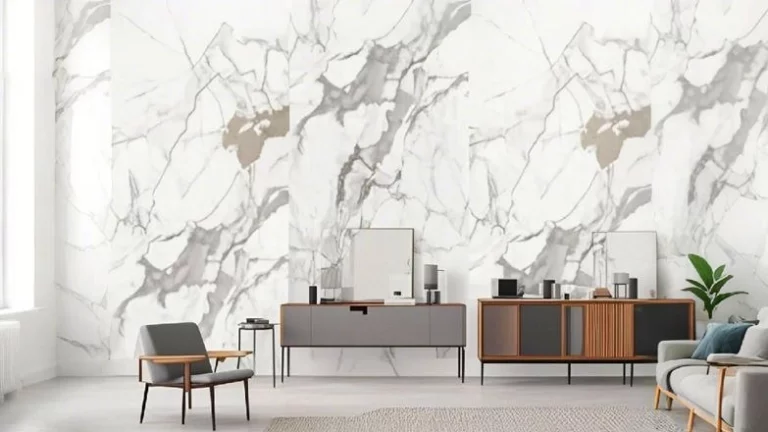
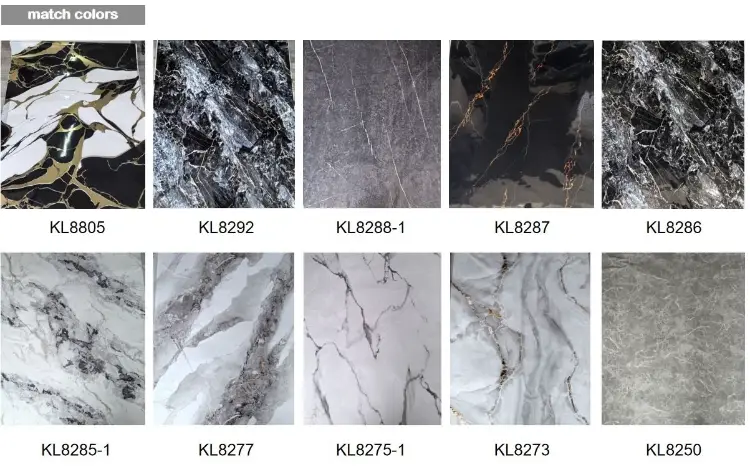
We produce HH24004 from PVC plastic and stone powder, with a UV marble face. The board is waterproof. Installation is laying and pasting.
Published size: 2.8 metres by 1.2 metres, length customizable. The listed rooms include bathrooms, alongside feature walls, background walls, bedrooms, and living rooms.
The width does the practical work at the sink. Take a 3.6-metre sink run. Three HH24004 slabs cover it, with two vertical joints. The same run in a 160 mm module takes 23 boards and 22 joints. Every joint removed is one less channel for steam. Set the bottom edge and the cut ends in the specification, and this board carries the wettest wall in the kitchen.
WPC wall panels: wood-look boards for the dry walls
We craft our WPC wall panels from wood fibers and recycled plastics. The named resistances are moisture, termites, and decay. The face needs no painting and no sealing.
WPC wall panel WP16001 is the shallow-grooved model: 10 mm thick, 160 mm wide, interlocking edge, natural wood grain finish. WP60001 is the wide flat option in the same material, at 8 mm by 600 mm.
Those specifications place the WPC line on the kitchen’s dry walls: the dining wall, the tall feature wall, the run opposite the hob. The line carries the same duty in living rooms, bedrooms, offices, hotels, and restaurants. The wall beside the pan and the strip behind the burners get other faces.
PS and MDF: light boards for the walls that stay dry
PS wall panels are polystyrene. The main models, F16002, F16003, F16004, and F16005, run 2.95 metres long and 16 cm wide, the length customizable.
The PS boards are waterproof and lightweight. Fixing is adhesive or nails. In a standard indoor environment they resist humidity and moisture. The listed rooms are interiors, bedrooms, living rooms, and feature walls, which covers a dining wall or a tall dry feature inside a kitchen.
MDF wall panels pair an MDF core with a wood-grain paper or a PVC wood-grain film. Standard length is 2.9 metres, a floor-to-ceiling run. Cleaning is a wipe with a damp cloth. Fixing is adhesives or clips. The named rooms are living-room feature walls, office partitions, hotel lobbies, and retail spaces. Both lines earn their place on the kitchen’s dry walls, away from the sink return and the cooktop rear.
| Material and model | What it is | Published size | Fixed by | Kitchen placement |
| SPC UV board HH24004 | PVC and stone powder, UV marble face, waterproof | 2.8 m × 1.2 m | Laying and pasting | Sink wall and splash zone |
| WPC wall panel WP16001 | Wood fibers and recycled plastics, shallow groove | 10 mm × 160 mm | Interlocking edge | Dry feature and dining walls |
| PS wall panels F16002–F16005, F11005 | Polystyrene, waterproof, lightweight | 2.95 m × 16 cm (F11005: 11 cm) | Adhesive or nails | Dry walls and tall features |
| MDF grille panels | MDF core, paper or PVC wood-grain film | 2.9 m standard length | Adhesives or clips | Dry feature walls |
Wall panels instead of tiles, wall by wall
Where panels take over the tile job
On the sink wall and the dry walls, panels do the work buyers usually hand to tiles, with fewer wet trades. A 1.2-metre SPC slab or a full-height 2.9- to 2.95-metre board covers its wall in a single piece, with no grout lines across the splash zone.
Grout is where grease and condensate sit longest on a tiled wall. Price the same 3.6-metre splash in 600 by 300 tiles and the drawing carries roughly six metres of grout line. A continuous panel face removes that maintenance line from the specification. Each wall also prices cleanly: one model, one size, one fixing method.
Where tile keeps its place
The strip directly behind the cooktop stays with tile, or with the surface the appliance instructions allow. It takes direct heat and the heaviest knocks in the room. A decorative board needs its own fire and heat documents before it can be specified there. Panels take the rest of the kitchen.
Place the panel by the load on that wall
The sink wall and the wall beside a boiling pot
This wall takes steam daily, and grease whenever the hob sits close. It gets the waterproof face: HH24004 across the splash zone. Measure the return, the window stool, and the outlet cuts before the quantity is locked. A 160 mm module and a 1.2-metre slab finish those cuts differently. The offcut on a return is where bare core would meet steam.
The prep wall and a tall feature wall
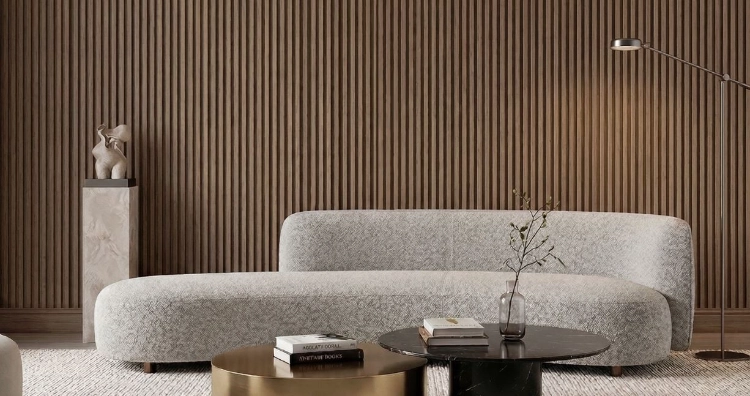
Away from the kettle and the burners, the tall wall takes the boards whose room lists already name feature walls: WP16001 in its shallow groove, a 2.9-metre MDF run, or a 2.95-metre PS board.
HH24004 also works here as the background slab, stopping at the edge of the heat zone. On repeat orders, groove spacing, marble vein, and film color go on the order with the model number; the next shipment has to match all three.
The wall directly behind a cooktop
The decorative order ends where the heat zone starts, and the appliance clearance governs the strip. If the drawing wants the marble field to continue, end HH24004 at the edge of that zone. Change to a surface the appliance instructions allow, under its own model number.
Edges, cleaners, and the sample a repeat order has to match
Close the edge before steam gets behind the panel
The MDF film wipes clean with a damp cloth, and the WPC face needs no paint or sealer. A cut end is a different component.
Steam cools at the worktop and finds the gap between panel and counter. A cover trim or a sealed return, called out with the model number, keeps that gap out of the finished wall. Fixing changes by line as well (see the table above), and the order names the method for the model it carries.
Clean grease without damaging the face
A damp cloth is the cleaning method named for the MDF line, for dust and ordinary marks. Beside a pan, the test is stricter. Try the project cleaner on the retained sample first. A solvent that cuts the film produces a face the next shipment cannot match.
Grease inside a groove still has to be reached. If the cleaner cannot reach it without abrading the film, that profile stays on a feature wall, and the pan wall gets the smoother face. Write the approved cleaner next to the finish code.
Match the film, the size, and the heat file before the order ships
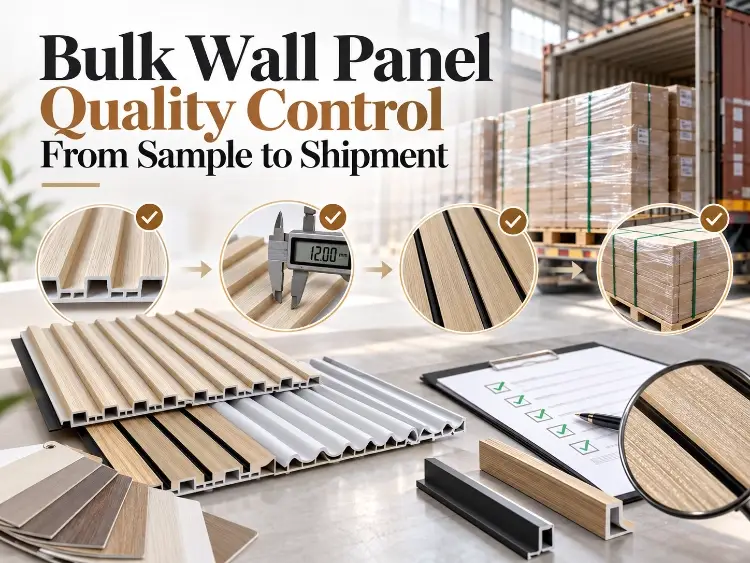
We keep standardized color codes and batch production for panels, skirting boards, and corner guards. We send free samples for confirmation.
Texture comes from a library of more than 10,000 options, or from a design you submit. Prototyping takes 72 hours. The minimum order is 1,000 meters. Small batches are negotiable for long-term partners. Production takes 15 to 45 days. Bulk orders include multilingual installation manuals, video tutorials, and online training.
The sample has to be the model on the order: WP16001 is 10 mm by 160 mm, HH24004 is 2.8 metres by 1.2 metres, the main PS models are 2.95 metres by 16 cm with F11005 at 11 cm, and the MDF line is 2.9 metres. Any wall near the cooktop also needs that model’s heat and fire documents in the sample packet. Send the wall list, the model, and the finish code to HUAHONG DECOR. Request samples against those sizes.
Conclusion
Order “kitchen wall panels” by the wall, not by the material name. Steam is a joint and edge problem. Grease is a face and groove problem. Cooktop heat is one short zone, and a waterproof face is no substitute for that model’s heat and fire documents.
“Kitchen wall panel materials” then sort themselves by the rooms published for each board. HH24004 takes the sink wall, which is also the honest answer to “pvc wall panels for kitchen”: the PVC-based board in our range is a sink-wall board. WP16001, the PS models, and the MDF line take the dry feature walls their specifications name. Send us the wall list before the order is priced, and we will match each wall to its model and sample.
FAQs
Q1: Can you put wall panels in a kitchen?
A1: Yes, wall by wall. The sink wall takes a waterproof face, the dry walls take the decorative lines, and the strip behind the cooktop follows the appliance clearance and the fire and heat documents of the model used there.
Q2: Is “WPC or PVC which is better for kitchen” one answer?
A2: No. In our range the PVC-based board is the SPC UV board HH24004, on waterproof duty at the sink. WP16001 is the 10 mm by 160 mm grooved WPC board, specified for dry feature walls. The cooktop strip waits on its own model’s heat and fire documents.
Q3: Can “waterproof kitchen wall panels” run from the sink to the cooktop?
A3: A waterproof face covers water, and the run continues across every wall water governs. At the cooktop strip the question changes: that model’s heat and fire documents and the appliance clearance take over. Specify the strip separately and the rest of the run stands.