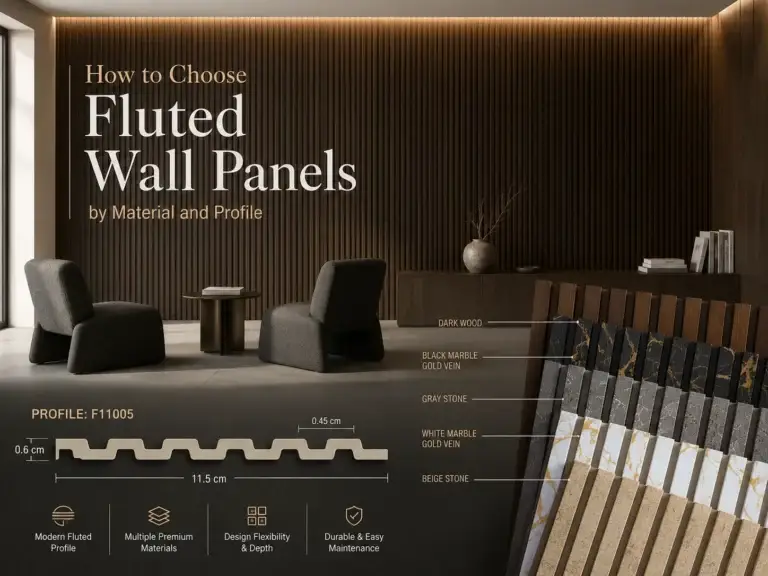

Ask a site foreman why a bathroom wall panel failed and the story rarely starts with the panel. It starts somewhere quieter: the spec was written off a catalogue photo, nobody confirmed what the cut edge does in water, and the seam detail was left to the fitter’s day. Three weeks later there is a tide mark on the join, or a corner that has lifted from the battens, and the “waterproof” panel is blamed for problems that the specification made almost certain.
That is why this guide speaks to the people who write the spec rather than the people who hang the panels. You might be a distributor deciding whether wet-room panels belong in the range at all, an importer putting together a container for a market that lives with high humidity year round, or a contractor who has just been asked for a quote on a hotel bathroom that will be scrubbed daily. The question is not which photo is prettier. It is whether the panel, at the thickness on the datasheet, with the seam detail as specified, will still be flat and sealed two years after the handover.
There is no single material that answers that. A wet-room wall is really four decisions stacked on top of each other: the substrate behind, the seam, the fixing, and the panel face. Get the order right and an ordinary panel survives; get it wrong and an expensive one fails. What follows is how to break the wall into those parts, which surface belongs on which wall, what to check when the container arrives, and how to write the specification so the factory and the installer are working from the same drawing.
PVC, WPC, and the Other Materials Used on Wet Walls
Searches for “PVC wall panels for bathroom” usually pull up three different products wearing the same label: solid PVC, wood-plastic composite, and a handful of engineered boards that only sound similar. The name on the RFQ is the least of your concerns. What matters is what each build-up does in a room that never dries out, and that is where the three families start to separate.
PVC panels: the workhorse for damp rooms
PVC is an extruded plastic, often with a printed or laminated face. The core is dense polymer, not wood fibre, so a properly made panel does not wick water into itself the way MDF or particle board does. That single property is why it earns its place on wet walls. Cut it with a hand saw, hang it light, and you still get a range from matte to gloss finishes. The catch sits in the build-up: a thin single-wall panel and a solid co-extruded one are sold side by side, and only one of them was ever meant to live next to a shower.
WPC panels: wood-plastic with a different failure mode
WPC blends wood fibre with plastic. The result is a warmer surface that carries fluted and grooved profiles beautifully, which is why it keeps winning the feature-wall argument. But the fibre content changes the rules: WPC holds its shape far better than timber, yet it is not as impermeable to water as solid PVC. In practice the joints carry the risk. A WPC bathroom wall has to be specified for its seams at least as carefully as the panel itself, or the wood component will do what wood fibre does when it gets a chance.
Then there are the look-alikes: SPC-backed panels and UV-coated marble-look boards, the latter aimed at a high-gloss, stone-style accent wall. Different products, different strengths, not interchangeable line items. The wall panel range keeps them under one category for exactly this reason: choosing is a system decision, not a material name.wall panel range
What “Waterproof” Actually Means on a Bathroom Wall
“Waterproof” is the laziest word in a wet-room spec. It almost always describes the panel, never the wall. A sheet that passes a 72-hour soak test can still lose the wall behind it when the joints are butted tight, the substrate sweats, or the room is an enclosed steam shower running near 100% humidity all afternoon. Judge the panel in pieces, because the pieces fail independently.
The panel face and the cut edge
Test the face. Then, separately, test the cut edge. The laminated surface can look fully sealed while the raw edge drinks water like a sponge, and that gap is where most wet-wall failures actually start. Push your supplier past the finished surface: what happens to thickness after prolonged contact, and what treatment is on the cut face? If the answer stops at the print layer, you have your risk. The edge is where every seam detail starts and ends.
The seam and the corner
Water does not attack the face of a wet-room wall; it works the joints. A butt joint with no allowance for movement will open within a season. Give the joint a sealed gasket, a corner bead, or a clipped return and it holds. This is where the specification earns its keep, because the panel maker does not control the joints and the installer is often not told about them. In a steam shower the seam detail decides the outcome, not the nominal rating on the box.
The substrate and the fixing
Mount a dry panel on a substrate unsuited to damp conditions and you have rebuilt the problem. The wall behind, the blocking or framing, and the fixing method, adhesive, screw, or both, all have to be rated for the same environment the panel faces. In cold climates add one more item: condensation forming behind the paneling. A vent gap or breather layer keeps that moisture moving instead of letting it sit on the framing. A supplier who quotes the panel but is silent about the substrate has left the wall’s most failure-prone part unwritten.
| Check | What it tells you | Spec / record |
| Water exposure test | Whether the panel face and the cut edge swell | 72-hour soak on panel and cut edge; % thickness change |
| Seam and corner sealing | Where water actually enters the wall | Sealed joint or abutted; corner bead / clipped return used |
| Substrate and fixing | Support on a wet wall | Moisture-resistant substrate; screw, adhesive, or both |
| Condensation allowance | Behind-panel moisture on cold-climate walls | Vent gap / breather layer behind paneling |
| Certification | Export and regional compliance | CE / EN 13986 where applicable |
Which Surface Fits Which Bathroom Wall
With panel, seam, and substrate settled, the last free choice is the surface. The trap is choosing it on style. The same gloss that photographs well in the catalogue will show every water spot on a wall the tenant wipes with a damp cloth once a month.
By the room’s moisture profile
A ventilated powder room is the easy case: with near-room humidity, both closed PVC and most WPC will serve it for years. A family bathroom with a long daily shower raises the stakes. An enclosed steam shower is the limit case, where the panel faces saturation for the whole session. The hotter and tighter the room, the more of the risk you should push onto seam detail and substrate, and the more you should insist that face and cut edge perform the same after a month of wet contact, not just after the factory soak.
By the finish you actually want to maintain
Gloss and UV-coated faces clean up in one wipe, which suits a bathroom on a weekly cleaning rota, but they broadcast water spotting and fingerprints. Matte and textured faces stay premium-looking with less effort, yet they hold soap scum in the low points if joint detailing is overlooked. Set this in the spec on purpose. Tell the contractor and the owner what “finished” means in practice, and who is doing the wiping.
One more variable the spec should name is climate. The same bathroom grade of panel ships into very different rooms depending on where your container lands. In a Gulf market the wall behind the panel dries fast and the finish takes punishing heat, so scratch resistance and UV stability on the face carry extra weight. In a tropical market the wall may never truly dry, so the moisture behaviour of the cut edge and the seam detail outrank the face style entirely. Naming the destination climate in the specification is not a formality; it tells the factory which failure mode you are defending against, and it is the first line of defence when a batch is audited against the order.
Inspecting a Batch Before It Goes Up a Wall
The spec protects you at the desk. Receiving inspection protects you at the dock. Ten minutes with a panel off the pallet catches failures that would cost a site visit to find. Run the same checks on the first container and every batch after it, and log the result against the batch number.
Start with thickness across the batch: a panel that drifts by a millimetre will not sit flat at the joints, no matter how good the adhesive is. Open a case and look at the cut edges for the treatment you specified. A batch that has lost its edge finish will start taking water at the seams within a season. Compare the face between panels that will hang next to each other, since a print lot change reads as a colour mismatch on a feature wall. Snap a corner off a sample and check the profile is still sharp, not softened in transit. Last, confirm the papers actually shipped with the goods: material declaration, the moisture data you asked for, and the certification the destination market requires. A panel specified for daily moisture should carry its evidence in the box, not only in the quotation you signed.

How to Specify and Source Bathroom Wall Panels
Buyers underestimate how much of this work happens on paper. A purchase order that names a finish and a quantity leaves every decision that actually protects the wall open, and those open decisions are where wet rooms fail. A complete wet-room panel specification fixes six things: the material build-up, the thickness, the face finish, the seam and corner detail, the substrate and fixing method, and the documentation the batch must carry. Write those down and the factory, your fitters, and the end client are all working from the same drawing.
Then sourcing stops being a price negotiation and becomes a matching exercise. You are looking for a manufacturer that will supply the build-up you wrote, not just a photograph of it, and that treats the seam detail as part of the package rather than an afterthought. HUAHONG DECOR works in this exact territory: its PVC and WPC wall panel lines cover the wet-room build-ups above, its لوحات الجدار WPC carry the fluted and grooved profiles that suit a feature bathroom wall, and its أرضيات SPC can be specified alongside for a coordinated wet-room order. For a wall that sees moisture every day, the supplier’s value shows up before the container loads: a confirmed edge treatment, the moisture data in writing, the seam detail on the drawing, and CE documentation matched to the destination market. That is the line between a panel that photographs well and one that still sits flat on the wall two years later.
A better procurement step
If the project is a bathroom, a hotel room, or a residential unit that has to keep its finish in a wet environment, send the build-up you are considering to هواهونغ ديكور and ask for the moisture and seam specification to be confirmed against it. Insist on a physical sample before the order is committed. A wet-room wall built on confirmed paper stops being a gamble the moment you are holding the panel that will actually be shipped.
FAQ
Q1: Are PVC wall panels suitable for a shower wall?
A1: Around the shower, yes, in enclosed wet rooms, yes, as long as seams, corners, and the substrate behind are detailed for constant moisture. The panel rating alone does not carry the wall: a butted joint and a substrate unsuited to damp conditions fail even when the panel itself passes the water test. In a steam shower, write the seam and substrate into the spec with the same firmness as the panel line item.
Q2: Is WPC better than PVC for a bathroom?
A2: They fail differently rather than one beating the other. PVC is the more closed, dimensionally stable pick for high-humidity walls, and it runs a wider finish range. WPC earns its place on feature walls where the wood look matters, but its fibre content shifts more of the risk onto joints and substrate. Harshest wet rooms: lean PVC. Feature-wall look with well-detailed seams: WPC works.
Q3: Can bathroom wall panels be customised in colour, size, or finish?
A3: Length, width, and face finish are routinely adjustable to a project, and colour or print matching is standard practice. One caution: a custom face does not change how the cut edge behaves in a wet room, so confirm the build-up and edge treatment with the custom order, and check the sample against your moisture and seam requirements before the full quantity.
Q4: What certification should a bathroom wall panel carry?
A4: For Europe and most export destinations, start from CE marking with the applicable building-product documentation, plus the material declaration and the moisture data your specification calls for. Which standard applies depends on the destination market and the panel’s classification there, so verify the papers shipped with the batch and that they describe the actual panels supplied.